How to Prevent Repetitive AI-Generated Posts and Comments in BuddyBoss and BuddyPress
Stop repetitive AI-generated posts and comments in BuddyBoss or BuddyPress with smarter prompts, varied topics, distinct voices, and a quality review workflow.
A community owner starts using AI to generate posts, comments, and replies inside a BuddyBoss or BuddyPress community. During the first few days, the results seem promising. New discussion posts appear, comments are published regularly, and the community feed contains more activity.
But after a few weeks, the owner notices something concerning. Different posts keep asking variations of the same question. Comments repeatedly begin with phrases such as "Great point!" or "I completely agree." Several supposedly different discussion participants use nearly identical sentence structures.
The content is technically different, but the conversations feel increasingly repetitive. Repetitive AI-generated posts can undermine the usefulness and credibility of community discussions, even when the content contains no exact duplicates.
Preventing repetition requires more than generating additional content. It requires distinct discussion topics, varied angles, contextual replies, appropriate persona guidance, and editorial quality checks. This article explains exactly how to build a better AI community content workflow.
Why AI-Generated Community Posts Start Sounding Repetitive
AI-generated content can begin repeating itself when community owners rely on generic instructions, limited topic lists, and similar conversation structures. AI writing tools can produce different words while repeatedly following the same underlying pattern.
For example, a community may publish "What is your biggest challenge with productivity?" followed by "What productivity problem are you facing this week?" and then "What's the hardest part of staying productive?" These questions may be grammatically different but are fundamentally asking for the same information.
Three common reasons repetition happens are vague or overly broad prompts, insufficient topic diversity, and repeated conversational structures. Each causes a different symptom but produces the same result: content that feels interchangeable.
Repetitive AI comments can be particularly noticeable because comments should respond to the specific discussion rather than sound like interchangeable reactions. For broader background on whether AI-generated community content can feel credible, the article on whether AI can really make your BuddyBoss or BuddyPress community feel active covers the larger question.
This article stays focused on identifying and improving content repetition rather than re-explaining whether AI engagement is useful.
The Difference Between Duplicate Posts and Repetitive AI Content
Many community owners overlook an important distinction. An exact duplicate occurs when substantially the same content is accidentally published more than once. This can sometimes be prevented through technical duplicate-processing safeguards.
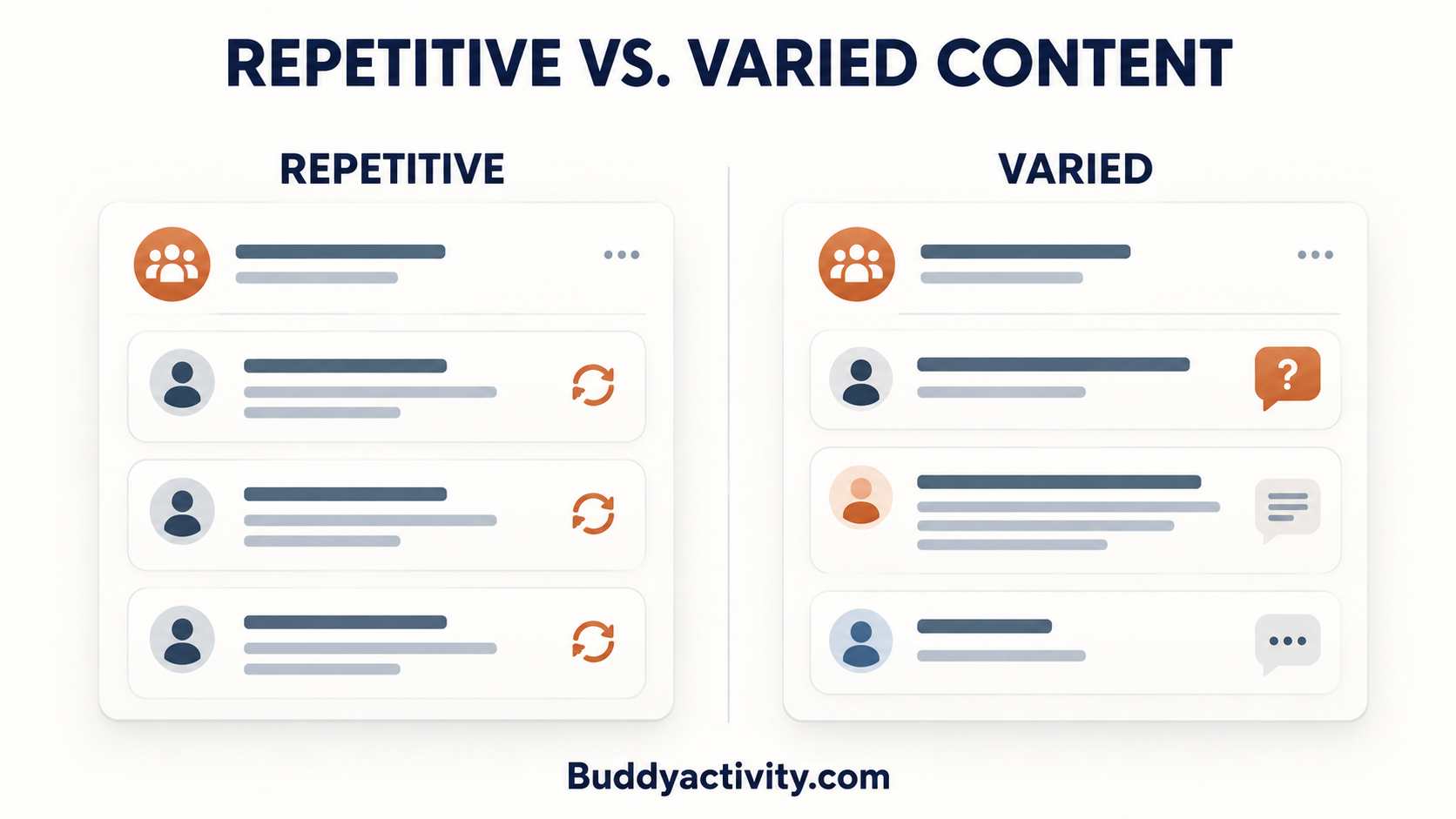
Semantic repetition is different. Two posts can use different words but deliver nearly identical ideas. For example, repeated questions about productivity challenges may create little new value even when no text is copied word for word.
Stylistic repetition is a third pattern. Every AI-generated comment may use a similar opening, sentence length, or tone regardless of the discussion topic.
These three problems require different solutions. Exact duplication requires publishing and processing controls. Semantic repetition requires topic and idea review. Stylistic repetition requires better variation in writing instructions and editorial checks.
A system capable of preventing duplicate publishing does not necessarily detect whether two discussions communicate the same idea. This distinction is essential to the rest of the article.
How to Recognize Repetitive AI-Generated Posts and Comments
Community managers can review a sample of recently generated posts and comments to identify patterns that may not be obvious when reading one discussion at a time. Reading several conversations together makes repetition far easier to spot.
Repeated Questions With Slightly Different Wording
AI frequently creates new versions of the same discussion question. A community might see "What's your biggest professional challenge right now?" one week and "What obstacle is holding back your business this month?" the next. Both ask the same underlying question.
An effective content review should identify the underlying question, not just compare the exact words. If two posts would generate similar answers from members, one is probably redundant.
Generic Comments That Could Fit Any Discussion
Comments such as "That's interesting," "Great advice," and "Thanks for sharing" can appear repeatedly without contributing much information. A brief acknowledgment is not inherently wrong, but a feed dominated by interchangeable responses offers limited value.
The difference between a generic acknowledgment and a contextual response is clear. A contextual comment refers to a specific point in the original post and moves the discussion forward.
Different Participants Using the Same Writing Style
Multiple AI personas can still sound similar when they receive nearly identical writing instructions. Repeated sentence structures, similar vocabulary, identical levels of enthusiasm, and predictable reply patterns all signal that the personas lack meaningful differentiation.
Examine several conversations together rather than judging a single post in isolation. A pattern that is invisible in one thread becomes obvious across five.
7 Practical Ways to Prevent Repetitive AI-Generated Posts in BuddyBoss and BuddyPress
1. Build a Topic Library Instead of Repeating Generic Questions
Community owners should not rely on a handful of generic engagement prompts indefinitely. A better approach is to create a structured topic library aligned with the purpose of the community.
For example, a professional WordPress community could organize topics into practical troubleshooting, client management, website performance, project planning, plugin compatibility, and professional development. Each category provides opportunities for different discussions.
Track recently published topics so the same central question is not repeated unnecessarily. Rotate topics without creating unrelated discussions simply for the sake of variety. Topic relevance matters as much as topic diversity.
2. Approach the Same Subject From Different Discussion Angles
Repeating a subject is not automatically bad. Communities often need to revisit important topics. The problem arises when every discussion asks essentially the same question.
One topic can support several distinct types of conversation. A topic about WordPress performance could become a troubleshooting question about a specific issue, a practical explanation of one optimization technique, a comparison of two implementation approaches, a discussion about a common mistake, or a request for members to describe their preferred workflow.
Each angle should contribute something new. Label the purpose of each planned discussion so you can identify unnecessary repetition before publishing.
3. Give AI Personas Distinct Communication Guidelines
AI-generated comments can become repetitive when every simulated participant receives the same generic instruction to be friendly and helpful. Distinct editorial roles can improve variation.
One clearly identified simulated persona might ask short clarification questions. Another might provide detailed technical explanations. A third might introduce a thoughtful alternative perspective. Different roles should influence vocabulary, response length, and the types of questions asked.
Avoid turning personas into exaggerated characters with unrealistic speech patterns. Content personas should be disclosed appropriately and must not be used to fabricate actual customer experiences or testimonials. For additional reading on participant configuration, the guide on using virtual members to seed your BuddyBoss or BuddyPress community covers how to set up recognizable personas.
4. Make Every AI Comment Respond to the Actual Post
Generic comments weaken discussion quality. A comment should respond to something specific in the parent post rather than simply express agreement.
Weak comment: "Great advice! This is really helpful."
Improved comment: "If the site is still loading slowly after the cache is cleared, would checking large image files be your next step?"
The improved comment is more useful because it relates to the original discussion and creates an opportunity for a meaningful follow-up. Provide the AI with the original post's context, topic, and intended discussion outcome when generating comments.
Do not invent technical claims or add unrelated follow-up questions solely to extend a thread.
5. Stop Threaded Replies From Repeating Earlier Comments
Repetition can occur deep inside a discussion even when the original post and first comment are useful. AI-generated replies may repeatedly agree, summarize the same point, or ask questions already answered earlier.
Replies should consider the conversation history rather than only the most recent message. A simple editorial rule helps: each new reply should clarify, extend, question, or meaningfully respond to an existing point.
For example, instead of restating that caching improves performance, a reply could share a specific situation where a caching plugin caused a conflict with a checkout page. That adds information rather than repeating it.
Stop a simulated conversation when there is no useful next contribution. More reply depth is not automatically better discussion quality.
6. Use Specific Context Instead of Generic AI Instructions
The difference between prompting AI to "write an engaging community post" and giving it a precise topic, audience, purpose, and discussion format is significant.
Weak instruction: "Write a discussion post for a WordPress community."
Improved instruction: "Write one concise discussion starter for experienced WordPress site owners comparing their approaches to handling plugin conflicts after an update. Ask one specific question. Avoid motivational phrases and generic advice."
Specific instructions reduce the likelihood of generic output. Include a limited set of relevant constraints rather than creating unnecessarily complicated prompts.
Prompts should not instruct AI to fabricate real member experiences, statistics, or endorsements.
7. Review Generated Content Before It Goes Live
AI-generated community activity still benefits from human editorial oversight. A content reviewer can identify near-duplicate ideas, repetitive comments, inaccurate information, mismatched tones, and threads that lack a clear purpose.
Review a sample of posts together rather than only checking them individually. Four useful quality questions help: Has this idea already appeared recently? Does the content offer a distinct contribution? Does the comment respond to the correct context? Would a community member find the discussion useful?
High-volume automation without review can amplify repetitive mistakes. Use the available draft and approval process where supported by your installed tools and configuration.
The objective is not perfection in every sentence, but consistency, relevance, and meaningful content variation.
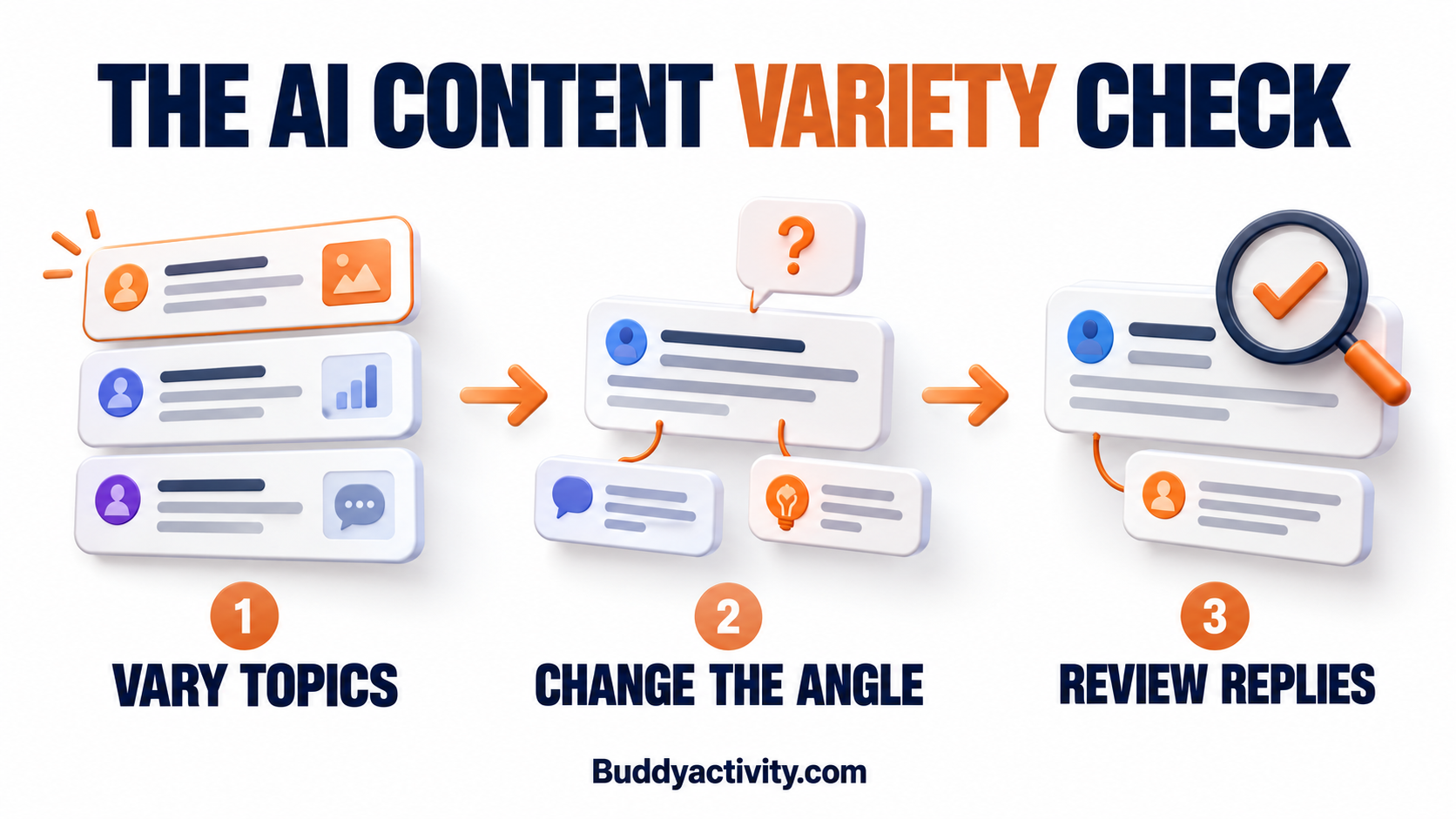
The Three-Step AI Content Variety Check
Community owners can create a simple repeatable review process before publishing AI-generated activity. The goal is a quick check that catches the most common repetition problems.
Step 1 — Vary Topics
Review the topics already published in the community. Check whether the proposed post introduces a different question, problem, or useful perspective. If it repeats a recent discussion without adding value, revise or replace it.
This can be managed using a simple topic tracking document or spreadsheet.
Step 2 — Change the Angle
Review the purpose and structure of the discussion. If several consecutive posts ask generic questions, introduce a specific example, comparison, explanation, or practical challenge where appropriate.
Make sure the change of angle produces a genuinely different discussion rather than superficial rewriting.
Step 3 — Review Replies
Check that comments and replies connect to the correct parent discussion. Look for repeated acknowledgments, irrelevant questions, duplicated explanations, and unsupported claims. Remove or revise responses that contribute nothing useful.
This final check improves the quality of the planned conversation before publication.
How BuddyActivity Supports More Varied Community Discussions
Managing a continuous stream of AI-generated posts, comments, and threaded replies manually can become difficult as a community grows. BuddyActivity is a WordPress plugin that supports AI-generated posts, comments, and replies in BuddyBoss and BuddyPress communities using configurable virtual members, persona behavior, conversation templates, and scheduled activity.
Its persona and author-selection features support variation in participation patterns and communication roles. Its AI and hybrid workflows can also give administrators control over the content they prepare and review.
These features do not automatically perform semantic similarity analysis, detect all repetitive ideas, guarantee originality, or replace the editorial workflow described in this article. The administrator remains responsible for reviewing topical relevance and content quality.
For additional reading on the general automation workflow, the guide on automating BuddyPress and BuddyBoss activity covers how scheduled activity works in practice.
How to Tell Whether Your AI Community Content Is Becoming Less Repetitive
Simply increasing the number of published posts does not prove content quality has improved. Assess a sample of community content before and after introducing better topic planning and review practices.
Four practical indicators help. Fewer discussions repeating the same underlying question. More distinct topics and discussion approaches. Fewer generic comments that could fit any post. More replies that directly respond to the context of the conversation.
Create a simple internal content review sheet and record patterns that need attention. These are editorial quality indicators rather than proven predictors of community growth or revenue.
Genuine member feedback is also valuable. If actual community members repeatedly say content feels generic or irrelevant, administrators should treat that feedback seriously and adjust the content workflow.
Frequently Asked Questions
Why does AI keep generating similar community posts and comments?
AI tools follow the instructions and patterns they are given. When prompts are vague, topic lists are short, or every persona receives the same writing guidelines, the output tends to converge. Different words can still express the same underlying idea, especially when the AI lacks specific context about what has already been discussed.
How can I stop repetitive AI-generated posts in BuddyBoss?
Start by building a topic library with distinct categories rather than reusing a few generic questions. Give each discussion a specific purpose and angle. Provide detailed context in your prompts, and review generated posts together before publishing to catch near-duplicate ideas that are not obvious one at a time.
Can different AI personas help create more varied BuddyPress conversations?
Yes, but only when each persona receives distinct communication guidelines. If every persona is told to be friendly and helpful, the output will sound similar regardless of the persona name. Assign different roles, vocabulary patterns, and response lengths to create genuine variation. Personas should be disclosed appropriately and should not impersonate real members.
Does BuddyActivity automatically prevent duplicate or repetitive AI content?
BuddyActivity includes features that support content variation, such as configurable personas, conversation templates, and author selection. These help reduce mechanical repetition. However, semantic repetition — two posts that use different words but express the same idea — requires editorial judgment. The administrator is responsible for reviewing topical relevance and ensuring content quality before publication.
Conclusion
Generating more AI content is not the same as producing better community discussions. Repetition happens when content generation lacks sufficient context, variety, and editorial judgment.
The central framework is straightforward: vary the topics, change the conversation angles, provide contextual comments, and review replies before publishing. AI automation is most useful when it supports a thoughtful content strategy rather than replacing one.
Review your most recent AI-generated discussions and identify one pattern you can improve immediately.
Was this article helpful?
Get fresh community insights in your inbox
Practical guides on growing engaged BuddyPress & BuddyBoss communities. No spam.
Keep reading
Browse all articles
Can AI Really Make Your BuddyBoss or BuddyPress Community Feel Active? Here's the Truth
Skeptical about AI community engagement? Here is an honest look at what AI can and cannot do for your BuddyBoss or BuddyPress community — and how to tell the difference between fake and authentic.
Read article
How to Use Virtual Members to Seed Your BuddyBoss or BuddyPress Community
Learn how to use virtual members to seed your BuddyBoss or BuddyPress community, solve the cold start problem, and get real members engaging from day one.
Read article
How to Automate BuddyPress & BuddyBoss Activity and Keep Your Community Engaged in 2026
Your BuddyPress or BuddyBoss community launched. Members joined. Then it went quiet. Learn how to automate BuddyPress and BuddyBoss activity so your feed stays alive, members keep coming back, and engagement builds on its own.
Read article